
Daily edition November 7, 2026
Daily AI-generated issue
AI engineering, November 7, 2026
Thinking Machines benchmarks Inkling 2 Small, REINFORCE Zero speeds training 2.40×, Google tackles distracting TODOs, OpenRouter’s Auto Code matches Claude Opus 5.5 at 74% less per task
This issue is researched and written by AI models, and every fact is checked against its cited source. No human edits it before it is sent.
- Agents
- Benchmarks
- Business
- Data
- Development
- Edition
- Daily
- Published
- November 7, 2026
- Read time
- 3 min
- Stories
- 3
Google found coding agents chasing bug tickets that were already closed. In Google's study, 41% of unprompted bug detours chased closed or otherwise dead-end tickets.
Meanwhile, Thinking Machines reports Inkling 2 Small scored 30.6 on AA Index v5.0, versus GLM-5.3-Flash's 27.8. REINFORCE Zero's authors report 2.40× synchronous training throughput with comparable quality.
If you read one thing today: REINFORCE Zero. Its released training code and kernel-alignment recipes let you test asynchronous RL in your own pipeline.
Key takeaways
- 01Inkling 2 Small scored 70.5% on JobBench, the highest result in the company's comparison.
- 02Coding scored 72.1% on DeepSWE v1.1 and 86.3% on SWEBench Pro v2 (Hard).
- 03The MoE has 594 billion total parameters, with 17 billion active. It accepts image inputs and supports variable effort.
- 04You can use it in Tinker Playground, or fine-tune and sample it on Tinker.
Top News · 284 HN points
Inkling 2 Small is Thinking Machines’ second-generation model for coding and autonomous work. Thinking Machines reports a 30.6 AA Index v5.0 score, ahead of GLM-5.3-Flash at 27.8 and MiniMax-M3.1-Flash at 29.1.
Here's what it offers:
- Inkling 2 Small scored 70.5% on JobBench, the highest result in the company's comparison.
- Coding scored 72.1% on DeepSWE v1.1 and 86.3% on SWEBench Pro v2 (Hard).
- The MoE has 594 billion total parameters, with 17 billion active. It accepts image inputs and supports variable effort.
- You can use it in Tinker Playground, or fine-tune and sample it on Tinker.
One catch: Initial access uses closed weights. Thinking Machines plans an Apache 2.0 weight release after external safety testing and red-teaming.
Sources: thinkingmachines.ai
Top News · Reported · vllm.ai
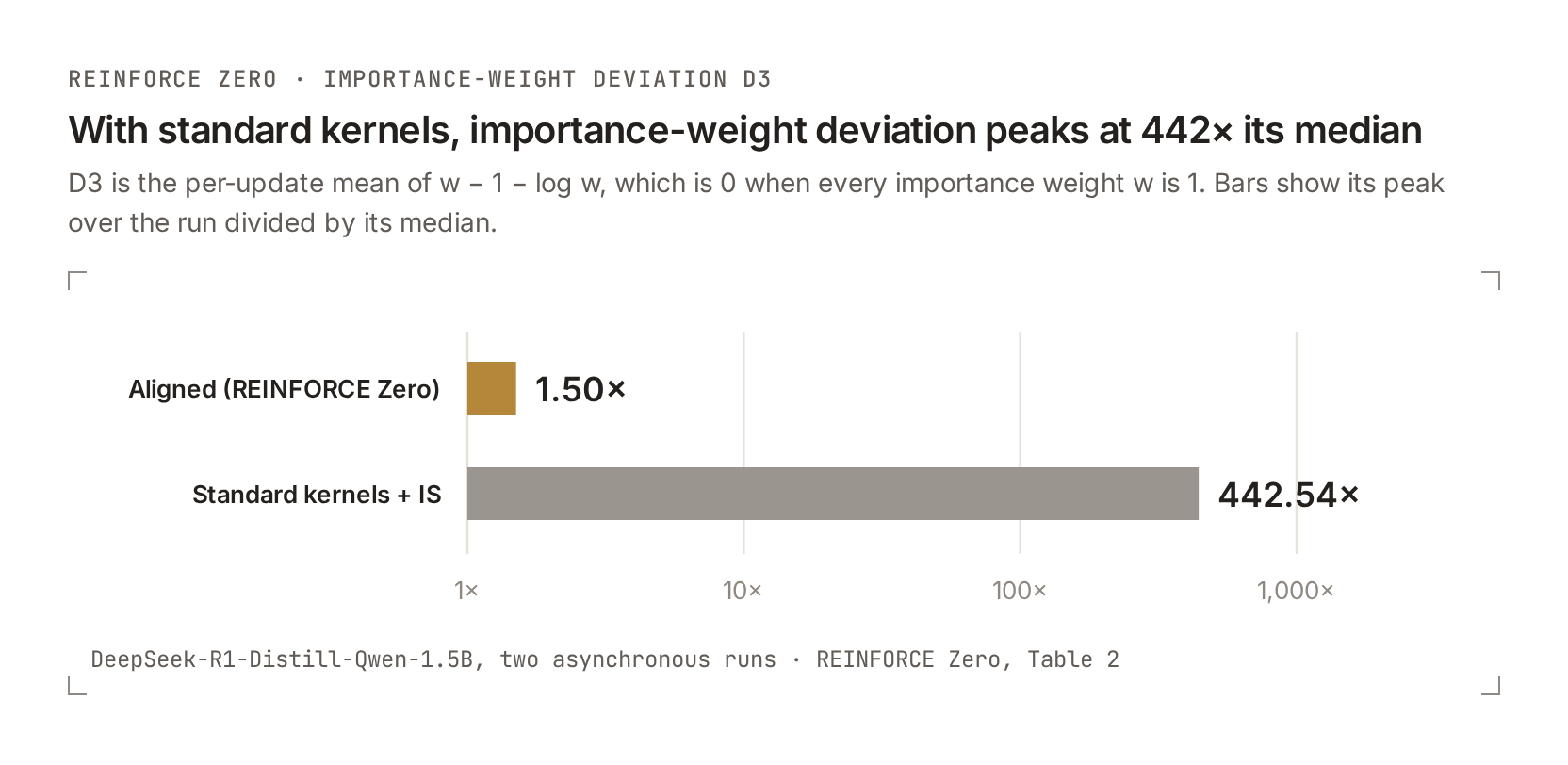
REINFORCE Zero is an asynchronous RL recipe. In the reported comparison, REINFORCE Zero kept reasoning quality close to synchronous training. The authors report 2.40× training-step throughput over 12,000 updates on 16 GPUs.
Here's what changed:
- Training took 68.55 hours, versus 164.77 hours for the synchronous run.
- The 1.5B reasoning comparison reached 48.80% macro pass@1 at lag 2, versus 48.91% for synchronous training at 6,000 updates. At lag 8, asynchronous training reached 48.53%.
- The recipe uses plain REINFORCE with group-relative rewards, without a value model or sample-rejection gates.
One catch: You need aligned rollout and training kernels, plus unclipped token-level importance sampling to correct policy-weight lag.
Try it: hijkzzz/REINFORCE-Zero for the paper and code, NVIDIA-NeMo/labs-molt for training code, and Inferact/zero-mismatch-rl for alignment recipes and model-specific fixes. Also available via Amazon Web Services, releasebot.io
Sources: vllm.ai

Top News
A TODO pointing at a bug can pull a coding agent away from your request. Google's engineering study associates these unprompted detours with 105% more wait time, after controlling for task and developer factors.
Here's what Google found:
- Detours were associated with 70% more steps and 77% more tokens per session, alongside the longer wait.
- Closed or otherwise dead-end tickets accounted for 41% of unprompted detours. Another 57% involved open bugs outside the developer's request.
- Cleanup agents inspected bug, file, and code-change history before proposing removals. The work removed thousands of obsolete references over six months, with more than 95% human-review acceptance.
- Google recommends presubmit analyzers, corpus scanners, and automated agents to catch and remove obsolete TODOs.
One catch: The measured effects are associations tied specifically to inline TODO(bug/...) and FIXME(bug/...) references.
Sources: developers.googleblog.com
Also in this issue
Signals
- OpenRouter’s Auto Code matches Claude Opus 5.5 across five benchmarks at 74% less per task
- AMD releases PrimusClaw, an open-source agent runtime for Kubernetes clusters with Instinct GPUs · Official · amd.com
- Zyphra releases ZYFA, running FP8 attention up to 1.76x faster than AITER on AMD MI355X · Reported · marktechpost.com
- Nous Research releases Arete-27B, a Qwen3.8-27B model post-trained to reinforce Western values
- Vercel’s agent-desktop lets AI agents control macOS, Windows and Linux apps without screenshots · 155 Stars today
- WeLM-Image-Turbo generates 1024×1024 images in 4.98 seconds on a single NVIDIA H20 · 39 Upvotes